“Pew, pew, pew!” a woman wearing sneakers and high-waisted pink trousers says cheerfully in a video uploaded to TikTok. She is standing on what appears to be an industrial rooftop while demonstrating how to use a black device resembling an oversized laser tag gun. “Jamming gun, good,” she adds, flashing a thumbs up. “Contact me!”
These days, nearly any product imaginable is available for purchase on TikTok straight from Chinese factories, ranging from industrial chemicals to mystical crystals and custom pilates reformers. The app’s offerings, it appears, now also extend to drone jammers and other drone-related hardware with clear military and security applications.
In recent months, TikTok has become an improbable showroom for a drone economy that powers conflicts like Russia’s war in Ukraine. Eager to reach customers however they can, small Chinese drone manufacturers are publicly broadcasting tools of modern warfare, including anti-drone rifles, jammers, and sensors, but presenting them with the breezy cadence of consumer lifestyle advertising. The result is a surreal combination of ecommerce and battlefield combat.
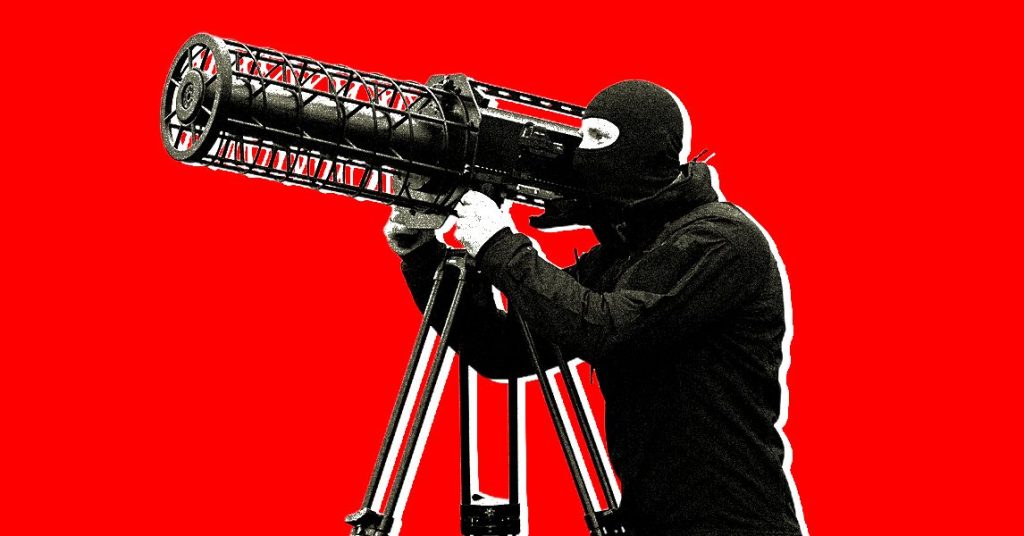
WIRED reviewed dozens of videos from TikTok accounts claiming to sell various types of anti-drone equipment, including products that look like a gumdrop-shaped dome on a tripod, a huge boxy “jamming gun,” and a backpack with 12 antennas. The captions on the videos are frequently in both Chinese and English, but others also include translations in Russian, Ukrainian, or other languages. One video set to bouncy industrial house music features what the user labeled as “9 band FPV anti drone jammer,” a device used to disrupt and block the radio and navigation signals that small drones use to communicate.
Drone Dependencies
Both Russia and Ukraine have raced to expand domestic drone production and strengthen their defenses against drone attacks. But much of that manufacturing still relies on Chinese componentry. Processors, sensors, speed controllers, cameras, and radio modules on both sides of the war are largely sourced from the same clusters of factories in and around Shenzhen, China’s hardware manufacturing capital.
“Even though Kyiv has tried to diversify away from Chinese sources, Ukraine still relies heavily on major Chinese companies for cheap drones and drone parts,” says Aosheng Pusztaszeri, a research associate at the Center for Strategic and International Studies focused on emerging technology and national security.
Beijing restricts exports of technologies that have both civilian and military purposes, including drones and related components, and it has repeatedly tightened those rules since the war in Ukraine began in early 2022. In September 2024, China expanded the controls to cover key parts needed to make battlefield drones, such as flight controllers and motors. Around the same time, the US government announced it was sanctioning two Chinese companies for allegedly selling drone parts to Russia.
Despite the restrictions, trade figures suggest that Chinese drones have continued flowing to Russia and Ukraine through intermediaries, says Pusztaszer. In the first half of 2024, Chinese companies officially sold only about $200,000 worth of drones to Kyiv. But the Ukrainian government puts the estimate much higher—at closer to $1.1 billion. “That gap suggests fully assembled Chinese drones and drone components might enter Ukraine via third-party sellers,” he explains.
Jamming On
University of Maryland engineering professor Houbing Herbert Song, who has researched anti-drone technology, tells WIRED that the products featured in the TikTok videos appear to be a combination of detection equipment and jamming equipment, the latter of which distorts the signals drones use to operate.
Drones typically use radio waves to communicate with a remote operator. Some jammers work by transmitting radio waves at the same frequency the drone uses to operate, which can cause the drone to lose contact with its operator and render it nonresponsive. However, if the drone can still connect to a navigation system, like the Global Positioning System (GPS), some drones can land themselves or return to their starting point. Other jammers attempt to interfere with the GPS signals drones use to navigate, or “spoof” them, tricking the drone into thinking it’s somewhere else.